
Checking Quality
Quality Checks
Configure and manage automated quality validation rules for your shipments.
8 min readLast updated
Goal
Configure automated rules that validate extracted shipment data, so problems show up before your team reviews a shipment, not after a customer finds them.
Checks answer one question: does this paperwork add up? They compare your extracted data against itself and against the totals the documents declare. They never assess the produce — for that, see Quality Inspection Reports.
Before you start
- Admin or Owner role. Members can see check results but not change which checks run.
- At least one processed shipment, if you want to see checks in action — checks run against extracted data, so there must be some.
How Checks Work
Each check receives the extracted pallet data and returns one of three results:
| Result | Meaning |
|---|---|
| ✅ Pass | Data meets all criteria |
| ⚠️ Warning | Potential issue, review recommended |
| ❌ Fail | Data does not meet requirements |
Checks run in parallel and complete within seconds.
Automatic AI Cross-Check
Some checks reconcile the extracted data against the totals the document itself declares — for example, whether the sum of per-pallet box counts matches the declared total box count (and the same for weights). A mismatch usually means a few figures were misread during extraction, which is most common with scanned packing lists where the original scan is faint or the table is dense.
Whether these checks can run depends on the documents. A packing list that declares its own totals can be verified against itself on every import. One that declares none is imported on trust, because there is no second figure to disagree with the first. If you can influence what your suppliers send, ask them to print total pallets, total boxes and total net weight. That change does more for extraction reliability than the file format, and it costs them nothing.
When a reconciliation check fails, Trackberry doesn’t just flag it. It automatically re-reads the original document with a secondary AI and tries to correct the data before you ever see a failure:
- It re-reads the packing list and, where it can match pallets, patches just the figures that were misread.
- If the pallet identifiers themselves were garbled, it rebuilds the packing list from the fresh AI read — but only if that read reconciles cleanly, and only when you haven’t made manual corrections to the packing list.
While this verification is running, the shipment shows a “Verifying documents…” status in place of preliminary check results, and the document displays a short progress label (e.g. “Discrepancies found — re-checking with secondary AI…”). Once the second pass finishes, the final check results appear. This stops failures that are about to be fixed from briefly showing on screen.
The cross-check only runs during automatic processing — a manual Run Checks re-run validates the current data without incurring additional AI processing.
Configuring Checks
Enabling/Disabling Checks
- Go to Settings > Checks in your organization
- Toggle individual checks on or off
- Changes take effect immediately for new shipments
Available Check Types
Trackberry includes several built-in checks:
Completeness Check
Ensures all required fields are present in the extracted data:
- Pallet number
- Produce name
- Calibre
- Box count
- Weight
Weight Validation
Verifies that box weights fall within expected ranges for the produce type. Flags outliers that might indicate extraction errors.
Box Counts Match
Reconciles the box counts extracted from the pallet rows against what the document declares about itself. Two independent signals are used where both are available: the declared total box count from the document header, and the count implied by the declared net weight divided by the box weight. The net-weight signal is reported first, because a header total can itself be misread. Box counts are whole numbers, so this check requires an exact match. The check is skipped when the document declares neither a total box count nor a net weight, because then there is nothing independent to compare the rows against.
Weight Totals Match
Reconciles the sum of the per-line net weights against the declared net weight on the document. Allows the larger of 0.5% or 0.01 kg. That covers the small rounding differences real exporter documents often have between a header total and the rows above it, without hiding a real misread. When the lines add up to a weight but the document declares none, the check warns that the figure is unverified. It is skipped only when there are no weights at all.
Pallet Count Matches
Compares the pallets in the packing list table with the load diagram drawn below it, and with the number of pallets the transport document declares, when it gives one. Fails when a pallet in the load diagram has no row in the table, or when the transport document’s count differs from the packing lists.
Calibre Consistency
Ensures calibre values match known standards for the produce type. For example, avocados typically have specific calibre ranges.
Duplicate Detection
Identifies potentially duplicate pallets within a shipment — same pallet number, produce, and calibre appearing more than once.
Invoice Total
Compares the sum of extracted invoice line item prices against the declared total on the invoice document. Uses a 1% tolerance to account for rounding differences. Fails when the calculated total diverges from the declared total by more than 1%, helping catch cases where the AI misread a price or missed line items. Skipped when no invoice data is available.
Invoice Matches Packing List
Cross-references the packing list against the commercial invoice for the same shipment — both describe the same physical goods, so they should agree. Compares:
- Produce — flags a failure when the packing list and invoice name completely different produce (e.g. one says Avocado, the other Asparagus), and a warning when they partially overlap.
- Box count — flags a failure when the packing list’s total boxes and the invoice’s total quantity disagree by more than 2%.
When it flags something, the check is renamed for what disagreed, such as Invoice / packing list box count mismatch or Invoice / packing list produce mismatch. Open Show details to see which document has more boxes and by how much.
This check never changes your data. It only flags a discrepancy for your team to review, because it can’t tell which document is correct. Check which one is right before exporting to Tradabase. See the Invoice Pricing guide for more on invoice data.
Before a TradaBase export: if this check, or the box count, weight, pallet count or invoice total check, has failed or warned, the shipment’s Export button turns amber and the export asks Export with unresolved data checks? first. Correct the data, or have an admin mark the check resolved, and the prompt stops.
Transport Reference Consistency
Detects conflicting AWB (Air Waybill) or B/L (Bill of Lading) numbers across different sources: the email subject line vs OCR extraction from transport document pages. This prevents issues where OCR misreads a transport reference on one page but the correct reference was provided in the email.
How it works: - Extracts transport references from the email subject (when AWB/MAWB keywords present) - Collects OCR results from each transport document page - Compares all values and flags discrepancies
Results: - Pass — All sources agree on the same reference number - Warning — 2 different values found (likely OCR error on one page) - Fail — 3+ different values found (severe data quality issue requiring review)
Prioritization: When conflicts are detected, the check recommends the most reliable value: 1. Email subject (plain text, most reliable — no OCR errors) 2. Majority vote (if multiple pages agree) 3. Later pages (often have clearer printing)
Why email subject is prioritized: Email subjects are plain text copied directly from carrier systems by shippers, making them more reliable than vision-based OCR that can misread digits on scanned/faxed documents (e.g., “006” misread as “057”).
Fix options: - Edit transport reference manually to correct value - Use the recommended value from email/majority - Re-upload a clearer transport document
Note: AWB numbers taken from email subjects are protected from OCR overwrites. If the email contained a valid AWB, that value stands even when a transport document page extracts a different number — the check flags the conflict for your review rather than silently replacing it.
Quality checks validate that your own extracted data is internally consistent. For an independent, third-party assessment of the produce itself (condition score, defects, photos), see the Quality Inspection Reports guide.
Automatic Data Completion
When the packing list is missing a value that the invoice states (box weight, variety, or pack format), Trackberry fills it in automatically from the matching invoice line. The packing list is always treated as the source of truth: this only fills in blanks, it never overwrites a value already on the packing list or one your team entered manually. Filled-in values are marked as such and can always be edited afterwards.
Re-Running Checks
Checks can be re-run manually:
- Open the shipment page
- Click Run Checks in the actions menu
- All enabled checks execute against the current data
- Results update in real-time
This is useful after: - Superseding a document with corrected data - Enabling new checks that weren’t active when the shipment was first processed - Updating check configuration
Check Results in the Shipment View
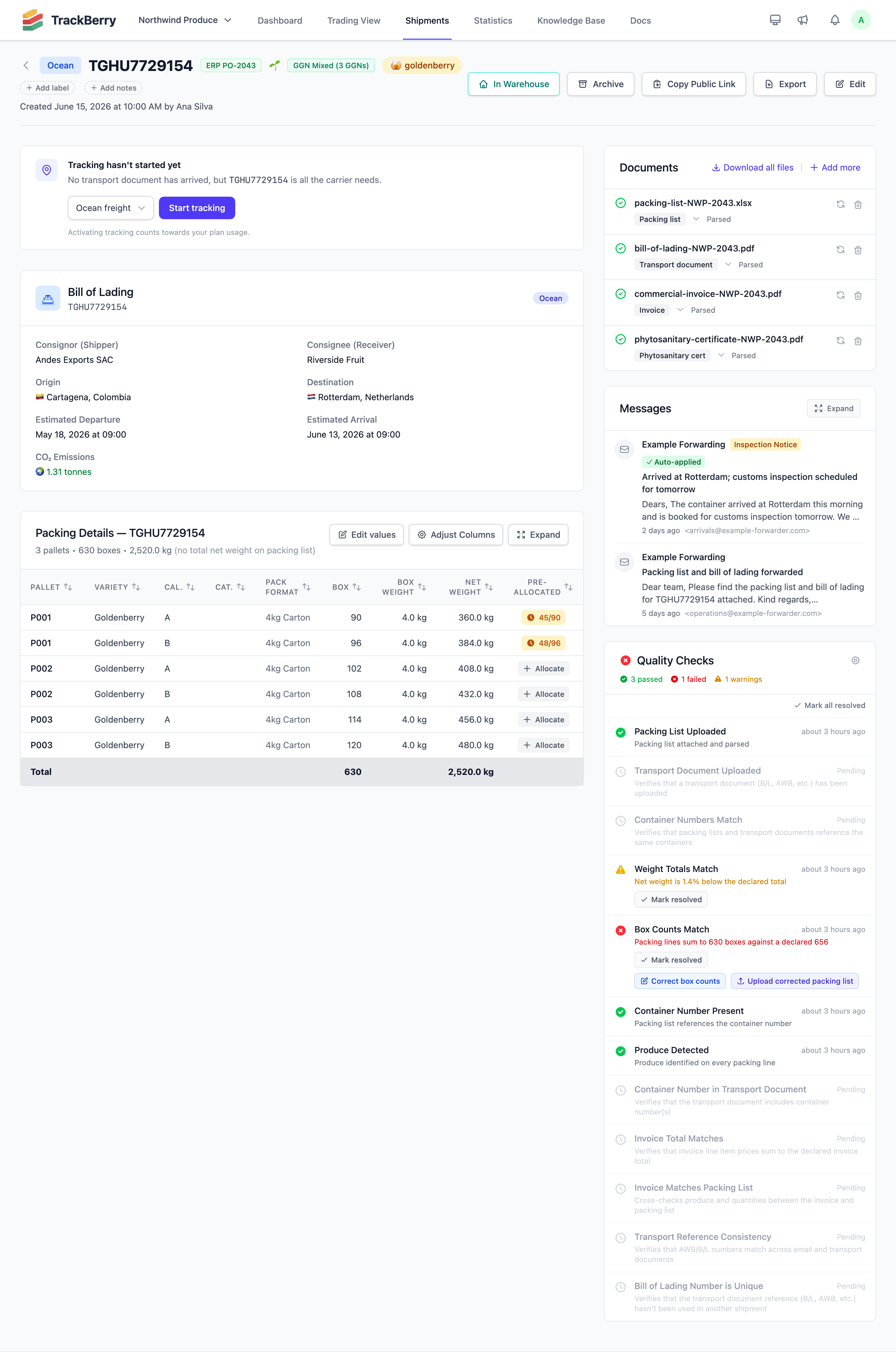
Check results appear prominently on the shipment page:
- A summary bar shows the overall status (all pass / warnings / failures)
- Each check shows its individual result with details
- Failed checks include an explanation of what was flagged
- Click on a check result to see which specific pallets triggered it
Resolving Issues
Not every flagged issue is fixed in Trackberry. Sometimes you call the shipper, confirm the figure was right all along, and the check has nothing left to tell you. Admins and owners can clear those:
- Skip a single check — on any failing or warning check, mark it resolved on its own.
- Mark all resolved — a link above the check list, shown only when there are open issues. It clears every failing and warning check on the shipment in one action, after a confirmation prompt.
Either way the check is recorded as manually resolved by you, with your email and the time — nothing is silently erased. Clearing the last issue lets the shipment validate itself automatically if it was being held back.
The Health Column
On the shipments list, check results share the Health column with monitoring alerts, so one dot answers both “does the paperwork add up?” and “is this shipment still moving?”
Hover the dot for a popover that lists monitoring alerts first, then each quality check with its status and message. The dot shows the worse of the two, and a dashed ring around it means monitoring has something to say.
See Shipment Monitoring for the other half of that column.